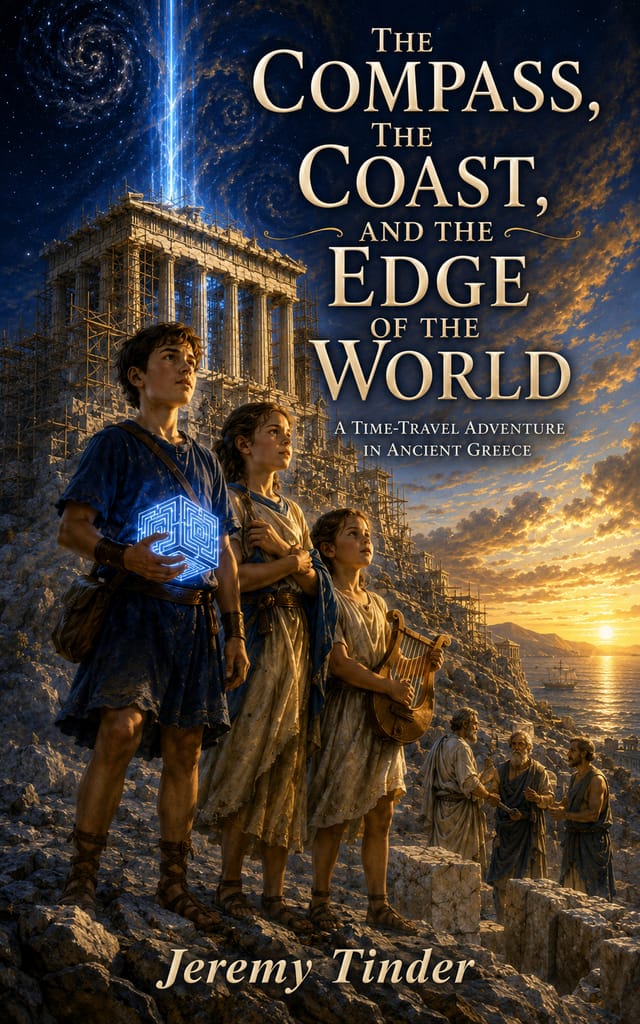
The Compass, The Coast, and The Edge of the World
A Time-Travel Adventure in Ancient Greece
Athens and the Acropolis (with a coastal fishing village en route) · Classical Greece, the Golden Age of Athens, during the construction of the Parthenon (mid-5th century BC, the age of Pericles)
Three weeks after their first journey to ancient Egypt, the ninth face of the mysterious cube begins glowing again, and the Carver children — Simeon, Beckah, and Ellie — are pulled through time to Athens during the Golden Age, at the height of the Parthenon's construction. Taken in by a local family and guided by a boy named Nikos, each Carver child finds a teacher who deepens the calling first discovered in Egypt: Simeon apprentices under a master sculptor and carves a horse into the Parthenon frieze, Beckah studies healing and language, and Ellie discovers her enormous voice belongs on the stage of an ancient theater. All the while, their parents back home wait on the porch, watching the light, and slowly become part of the secret instead of standing outside it.
- Reading age8-12
- Length417 pages
- Series orderBook 2 of 15
- RegionAncient Greece, Attica
Get the book
Retailer links marked “coming soon” are placeholders until the official store links are published.
What readers will discover
- The Golden Age of Athens under Pericles
- The construction of the Parthenon and Doric architecture
- Classical Greek marble sculpture and the Parthenon frieze
- The Athenian agora, commerce, and daily city life
- Ancient Greek theater and its role in civic life
- Early Greek philosophy and the Socratic method (a young 'Sokrates')
- Greek language basics and communication across a language barrier
- The status and roles of women in classical Athenian society
Main characters in this book
- Simeon Carver
- Eldest Carver child, 14, a builder like his father who apprentices as a stonecutter on the Parthenon
- Beckah Carver
- Middle Carver child, 12, a linguist and healer-in-training who studies Greek and continues her medical education
- Ellie (Eleanor Grace) Carver
- Youngest Carver child, 9, 'the voice,' whose big personality and stage presence find an outlet in an Athenian theater
- Daniel Carver (Pa)
- The children's father, a builder in Oakdale, North Carolina, who keeps the cube hidden beneath the shed floor
- Elizabeth Carver (Momma)
- The children's mother, a Filipino-American homemaker who senses her children have changed and grows closer to the truth
- Nikos
- Athenian boy who befriends the Carver children and guides them through the city
- Doros
- Master sculptor overseeing the Parthenon frieze workshop who mentors Simeon
- Sokrates
- A young stonecutter and philosopher on the Parthenon site who questions Simeon about building, truth, and beauty
- Phoebe
- Athenian woman who continues Beckah's education in healing and herbal medicine
Themes & learning topics
Guidance for parents & educators
Family-friendly middle-grade adventure with mild period-appropriate peril (crowded ancient streets, physically demanding labor, heat, separation anxiety) but no graphic violence, gore, or on-page death. Themes of family faith are present through Bible readings and prayer, handled warmly and without preachiness. No depiction of 'the Maker' as a visible character. Some emotional intensity around family honesty/secret-keeping and a child processing fear and change.
Recommended reading age: 8-12.
Questions about this book
Spoiler-free answers, drawn from the book itself. Spoiler answers are clearly marked and tucked behind a click.
What is 'The Compass, The Coast, and The Edge of the World' about?
It's the second book in The Cube Chronicles, in which the Carver children are pulled by their mysterious cube into ancient Athens during the Golden Age, right as the Parthenon is being built.
#Do I need to read Book 1 first?
Yes, it's strongly recommended. Book 2 picks up three weeks after the events of Book 1 (set in ancient Egypt) and references that trip, the cube's discovery, and the children's growth from it throughout.
#Where and when does this book take place?
The story is set in Athens, Greece, during the Golden Age of the 5th century BC, while the Parthenon is under construction on the Acropolis under the leadership of Pericles.
#Who are the main characters?
The three Carver siblings — Simeon (14, the builder), Beckah (12, the healer and linguist), and Ellie (9, the voice) — along with their parents Daniel and Elizabeth Carver back home in North Carolina.
#What age group is this book appropriate for?
It's written for middle-grade readers, roughly ages 8 to 12, with rich vocabulary and historical detail that also appeals to strong younger readers and adults who enjoy family-friendly historical fiction.
#Is this book based on real history?
Yes. The setting draws on real historical details of classical Athens, including the construction of the Parthenon, the Athenian agora, Doric architecture, Greek theater, and the intellectual culture of the era, including a young stonecutter named Sokrates.
#How does the time travel work in this series?
An ancient, nine-sided cube found beneath the Carver family's shed glows and transports the children through history when one of its symbols finishes forming. It has already taken them to ancient Egypt and, in this book, to ancient Greece.
#Is this book appropriate for a classroom read-aloud?
Yes. It pairs adventure fiction with real historical content about ancient Greece — architecture, philosophy, theater, and civic life — making it a natural companion to a classical civilizations unit.
#What themes does the book explore?
Family, honesty, courage, and the idea that true craftsmanship combines function with beauty — echoed through the children's parallel lessons in Egypt (endurance) and Greece (beauty) and their father's practical building philosophy back home.
#Is there anything frightening or violent in this book?
No. The book is family-friendly with no graphic violence or gore. There is some tension from crowded, unfamiliar surroundings, physical labor, and a family's fear of secrets, but nothing intense or scary for its middle-grade audience.
#Does the book include faith or religious themes?
Yes, in a warm, natural way. The Carver family is shown praying and reading Scripture together at home, and their faith is portrayed as part of the emotional and moral foundation the children carry with them through their travels.
#How long is the book?
It's approximately 107,900 words, or about 417 pages in the KDP paperback edition — a substantial read for confident middle-grade readers.
#What can kids learn about ancient Greek culture from this book?
Readers get an immersive look at daily life in classical Athens: the bustling agora, Doric temple construction on the Acropolis, Greek theater and performance, early philosophy, and the social norms of the time, including the restricted roles of women.
#What happened just before this book, at the end of Book 1?
The Carver children had just returned from their first crossing to ancient Egypt, where they helped build near the Great Pyramid and formed bonds with an Egyptian family. Book 2 opens three weeks later as the cube begins to activate again.
#What is set up for the next book in the series?
By the end of the book, the cube's ninth face is already forming a new symbol, and the family agrees all five of them will be present for the next crossing, setting up Book 3's journey to a new, still-unspecified civilization.
#Do the Carver parents find out about the cube in this book?Spoiler
This answer reveals plot details.
Yes. Although Daniel and Elizabeth don't witness the full truth of time travel firsthand, by the story's end they've moved from suspicion to full awareness, and they plan to be present in the yard for the next crossing.
#Does Simeon leave a lasting mark on a real historical monument?Spoiler
This answer reveals plot details.
Yes — under the mentorship of a master sculptor, Simeon carves a galloping horse into the Parthenon frieze, a piece of the actual historical monument that (in the present day) resides in the British Museum.
#Does Ellie get to use her big personality in this book?Spoiler
This answer reveals plot details.
Yes — Ellie's larger-than-life voice, which gets her in trouble at school, becomes an asset when she performs before a massive crowd in an ancient Athenian theater, discovering that the very thing adults ask her to quiet down is actually a gift.
#Reader questions & answers
No approved reader questions yet. Be the first to ask!
Ask a question about this book
Sign in or create a free account to ask a question. You never need an account to read.