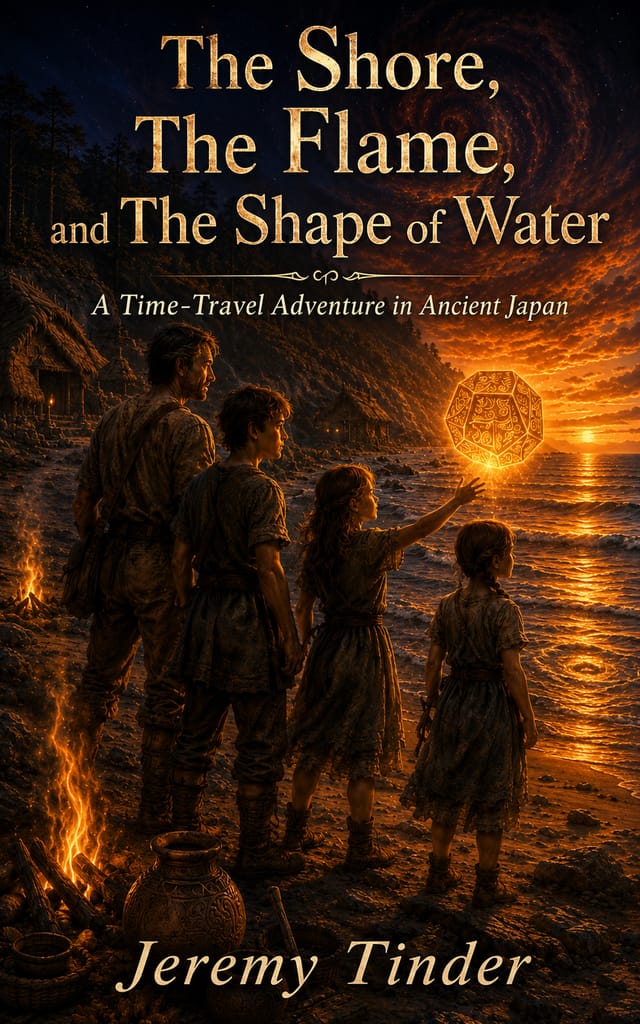
The Shore, The Flame, and The Shape of Water
A Time-Travel Adventure in Ancient Japan
A Jōmon-period fishing and pottery village on a black-sand Pacific coast · Prehistoric Japan, Jōmon period, circa 2500 BC
The cube's fifth configuration glows warm amber-orange and carries the Carver siblings across the Pacific to a Jōmon-period fishing village in ancient Japan, where they learn pottery, drumming, and cord-making from village children their own age while their parents wait at home in Oakdale.
- Reading age8-12
- Length221 pages
- Series orderBook 5 of 15
- RegionAncient Japan
Get the book
Retailer links marked “coming soon” are placeholders until the official store links are published.
What readers will discover
- Jōmon-period Japan and prehistoric island life
- flame-style pottery and cord-marked ceramics
- traditional drumming and rhythm
- dogū clay figures and symbolic healing practices
- early maritime and volcanic geology
- herbal medicine (willow bark, comfrey) in ancient healing
- archaeological methods such as pottery seriation
Main characters in this book
- Simeon Carver
- Eldest sibling, age 15, apprentices as a builder/craftsman and reflects on his growing identity as a maker
- Beckah Carver
- Middle sibling, keeps the family's field notebooks and studies Jōmon medicine, pottery, and the clay dogū figures
- Ellie Carver
- Youngest sibling, age 10, learns rhythm and drumming and blends the mountain song from Book 4 with a new island melody
- Daniel Carver
- Father, a builder from South Carolina who frames the family's lessons in terms of craftsmanship and faith
- Elizabeth Carver
- Mother, manages practical preparations for each crossing and tends the family's spiritual life
- Hana
- Jōmon potter girl who befriends Simeon and shares flame-style pottery techniques
- Kai
- Jōmon drummer boy, age 10, who teaches Ellie rhythm and gives her his own drumsticks
- Yua
- Jōmon cord-maker girl who exchanges knotted-cord keepsakes with Beckah
- Chiyo
- The village healer who treats injuries with herbal medicine alongside symbolic clay dogū figures
- Oto
- A village fisherman whose injured shoulder is treated by Chiyo using both practical medicine and a dogū figure
Themes & learning topics
Guidance for parents & educators
Family-friendly middle-grade historical fiction with light peril (a fisherman's injured shoulder, references to past crossings' dangers) and mild bittersweet emotion around aging and impermanence; explicit but age-appropriate Christian faith content (family prayers, Scripture readings, references to God, 'the Maker' as a guiding but never visibly depicted presence) woven throughout; no violence beyond an incidental injury, no romance, no profanity.
Recommended reading age: 8-12.
Questions about this book
Spoiler-free answers, drawn from the book itself. Spoiler answers are clearly marked and tucked behind a click.
Where and when is this book set?
The fifth book takes the Carver children to a Jōmon-period fishing village on a black-sand Pacific coast in ancient Japan, around 2500 BC.
#Do I need to read the earlier books first?
It helps but isn't strictly required. Book 5 references earlier crossings (Egypt, Greece, the Indus Valley, and China) and callbacks like Mei's mountain song, but the Japan storyline stands on its own.
#Who are the Carver children in this book?
Simeon (15), Beckah, and Ellie (10) are the three siblings who travel through the cube; their parents, Daniel and Elizabeth, stay behind in Oakdale, North Carolina.
#What new friends do the children make in this book?
Simeon befriends Hana, a young potter; Ellie learns drumming from Kai; and Beckah exchanges keepsakes with Yua, a cord-maker. The healer Chiyo and fisherman Oto also feature prominently.
#Is this book appropriate for younger middle-grade readers?
Yes. It's written for ages 8-12 with no profanity or romance and only mild, non-graphic peril, such as a fisherman's injured shoulder.
#Does the book include religious content?
Yes. Like the rest of the series, the Carver family's Christian faith is woven throughout, including mealtime prayers and Scripture readings, and the story draws a parallel between a potter mending broken pottery and spiritual restoration.
#Is 'the Maker' shown directly in the story?
No. The Maker is referenced as a guiding, providential presence in the family's faith and conversations but is never depicted or shown visibly on the page.
#What historical topics does this book teach?
Readers learn about Jōmon-period pottery techniques (flame-style ceramics and cord-marking), traditional drumming, dogū clay figures used in healing rituals, and early herbal medicine such as willow bark for pain relief.
#How does the time-travel cube work in this book?
The cube reveals a new glowing configuration for each destination; in this book its warm amber-orange glow and rising heat signal a fire-and-water theme, guiding the children to the correct time period and location.
#What skill does Ellie learn in Japan?
Ellie learns village drumming and rhythm from a boy named Kai, and by the end blends it with the mountain flute song she learned from Mei in an earlier book.
#What does Beckah study during this crossing?
Beckah documents Jōmon medicine, comparing practical herbal remedies to the symbolic use of dogū clay figures in healing, and reflects on this contrast in her field journal.
#Is this the final book in the Cube Chronicles?
No. The book closes noting that a sixth cube configuration is already forming, signaling more crossings and destinations ahead in the series.
#Would this book work well for a classroom read-aloud on ancient civilizations?
Yes, it pairs an engaging adventure story with grounded details about Jōmon Japan's pottery, tools, and community life, making it useful alongside a world-history unit.
#Does the injured fisherman, Oto, fully recover in the story?Spoiler
This answer reveals plot details.
The book shows him being treated with herbal medicine and a symbolic dogū ritual that eases his fear, though it is clear his physical healing will still take weeks beyond the story's timeframe.
#What happens with the exchanged gifts between the children at the end?Spoiler
This answer reveals plot details.
Ellie gives Kai a Pacific beach stone and receives his own drumsticks in return, while Beckah and Yua trade cord and clay tokens bearing each other's identifying marks, symbolizing their cross-time friendships.
#Does the book end with a cliffhanger?Spoiler
This answer reveals plot details.
Not a dramatic cliffhanger, but it ends with a strong forward hint: Daniel notes a new, sixth cube configuration is forming, promising another destination in the next book.
#Reader questions & answers
No approved reader questions yet. Be the first to ask!
Ask a question about this book
Sign in or create a free account to ask a question. You never need an account to read.