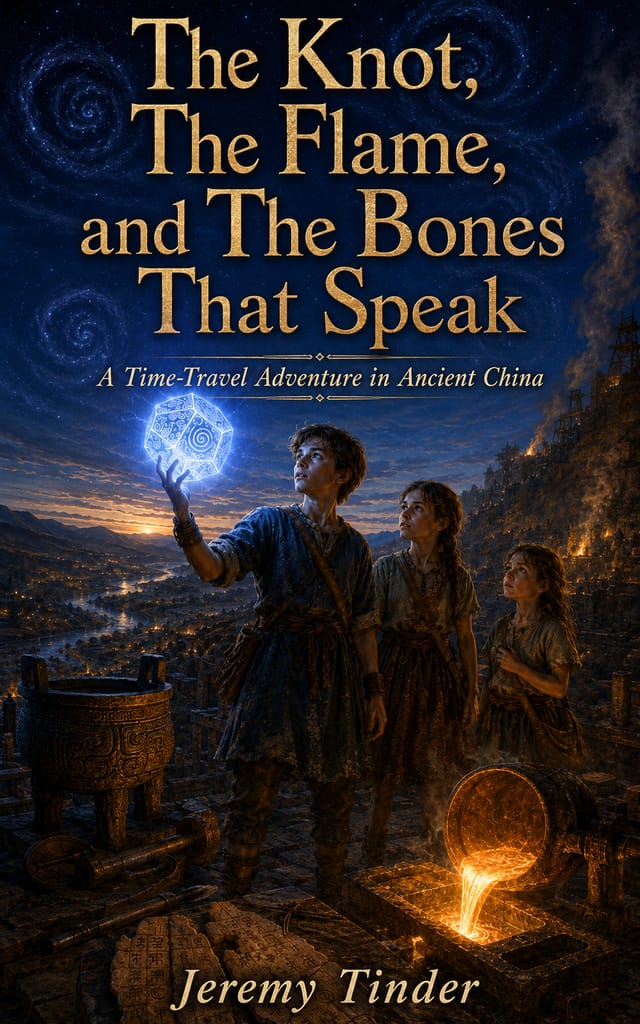
The Knot, The Flame, and The Bones That Speak
A Time-Travel Adventure in Ancient China
A silk-weaving and bronze-casting mountain village on a cliff terrace above the Yellow River · circa 1900 BC
The mysterious cube's ninth face grows a fourth, crystalline configuration glowing cold blue-white, and the Carver children cross into a mountain village above the Yellow River around 1900 BC. There Simeon apprentices with a bronze-master to build and fire his own furnace, Beckah studies both a silk-cord counting system and an oracle-bone diviner's fire-cracked prophecies, and Ellie is entrusted with a flute and a mountain song passed mother to daughter for generations. Together the siblings piece together what fire, transformation, and faith have in common as their family's fourth crossing tests the foundation built by three journeys before it.
- Reading age8-12
- Length314 pages
- Series orderBook 4 of 15
- RegionAncient China (Yellow River highlands)
Get the book
Retailer links marked “coming soon” are placeholders until the official store links are published.
What readers will discover
- early Chinese Bronze Age metallurgy and furnace-building
- oracle bone divination and its role in agricultural planning
- knotted-cord (quipu-like) record-keeping systems
- silk production and weaving
- oral musical tradition and transmission
- the Yellow River valley's early Bronze Age society
Main characters in this book
- Simeon Carver
- Eldest Carver sibling; apprentices under bronze-master Zhou, learning to build and fire a clay furnace
- Beckah Carver
- Middle Carver sibling and family record-keeper; studies the village's knotted silk cords and an oracle-bone diviner's craft
- Ellie Carver
- Youngest Carver sibling; learns a generations-old mountain song on a crane-bone flute from a village girl
- Daniel Carver
- Father; master builder whose faith and craft lessons frame each crossing
- Elizabeth Carver
- Mother; provisions, protects, and grounds the family with prayer and food between crossings
- Zhou
- Village bronze-master who teaches Simeon furnace-building and metalwork
- Liang
- Zhou's apprentice, who translates and guides Simeon through the bronze workshop
- Mei
- Village flute-player who passes down her family's mountain song to Ellie
- Hua
- Weaver's daughter who teaches Beckah the village's knotted-cord counting and record system
Themes & learning topics
Guidance for parents & educators
Family-friendly middle-grade content; depicts high-temperature furnace work and its real dangers as a craft challenge (no injuries to protagonists), an oracle-bone divination ritual presented as a historical practice the children observe and discuss thoughtfully, and Carver family Christian faith and prayer as recurring, integrated elements. No graphic violence; no romance. The Maker/Builder is referenced in the family's faith but never depicted or shown.
Recommended reading age: 8-12.
Questions about this book
Spoiler-free answers, drawn from the book itself. Spoiler answers are clearly marked and tucked behind a click.
What civilization does Book 4 take the Carver children to?
A mountain village above the Yellow River in ancient China, around 1900 BC, known for silk weaving, bronze casting, and oracle-bone divination.
#Do I need to read the first three Cube Chronicles books before this one?
It helps but isn't required. Book 4 recaps the cube's rules and the family's prior crossings (Egypt, Greece, and the Indus Valley) as the children compare this trip to earlier ones.
#What does each Carver sibling learn or do in this book?
Simeon apprentices with a village bronze-master to build and fire his own furnace; Beckah studies the village's knotted-cord counting system and an oracle-bone diviner's practice; Ellie learns a generations-old song on a bone flute.
#Is this book historically accurate?
The novel is grounded in real historical practices of early Bronze Age China, including bronze furnace technology, oracle bone divination tied to agricultural planning, silk production, and knotted-cord record-keeping, presented through the children's firsthand observation and questions.
#Is the oracle-bone divination scene appropriate for kids?
Yes. It's presented as a real historical practice the children observe respectfully and discuss thoughtfully, weighing what the diviner might be interpreting versus predicting from experience. It is not depicted as anything supernatural threatening to the children.
#Does this book contain violence or scary content?
No graphic violence. The furnace work involves real heat and danger as part of the craft lesson, but no characters are harmed. Tension comes from learning difficult skills and understanding a new culture, not from combat or peril.
#Is the cube itself ever explained in this book?
The cube continues to reveal itself gradually. In this book its ninth face grows a new crystalline configuration with a cold blue-white glow tied to the destination's element, fire, continuing the pattern established in earlier books.
#Is faith a big part of this book?
Yes. The Carver family's Christian faith, prayer, and Bible readings are woven throughout, especially in father Daniel's reflections connecting the furnace's transforming fire to spiritual themes of renewal and purpose.
#Is the Maker or God shown directly in the story?
No. The family speaks of the Builder/Maker and prays, but the Maker is never depicted or made visible; faith is expressed through the family's words, traditions, and reflections rather than any direct appearance.
#What age group is this book best suited for?
Ages 8 to 12, consistent with the rest of the Cube Chronicles series, though older middle-grade readers who enjoy detailed historical description will also find plenty to like.
#Who are Mei, Hua, Zhou, and Liang?
They are villagers the Carver children befriend and learn from: Mei teaches Ellie a mountain flute song, Hua teaches Beckah the knotted-cord record system, Zhou is the bronze-master who trains Simeon, and Liang is Zhou's apprentice who helps translate.
#How long is the book?
About 79,700 words, roughly 314 pages in the KDP paperback edition, across 30 chapters in four parts.
#Would this book work well for a classroom or homeschool unit on ancient China?
Yes. It covers bronze-casting technology, oracle bone divination, silk production, and early record-keeping systems in vivid, accurate detail, making it a strong companion to a unit on early Bronze Age China.
#Does Simeon succeed in building his furnace?Spoiler
This answer reveals plot details.
Yes — after failed early attempts and patient correction from Zhou, Simeon eventually builds a furnace capable of holding the heat needed for bronze casting, marking his mastery of the fourth civilization's central craft.
#What does Ellie bring home from her time with Mei?Spoiler
This answer reveals plot details.
Ellie learns the complete mountain song passed down through generations of mothers in Mei's family, and carries the bone flute itself back to the Carver home in 1987, where she can still play the ancient melody.
#Does the book end with a cliffhanger?Spoiler
This answer reveals plot details.
Not a cliffhanger in the danger sense — the fourth crossing resolves safely and the family returns home. But the ending shows the cube's ninth face already growing a fifth configuration, setting up the next civilization and book.
#Reader questions & answers
No approved reader questions yet. Be the first to ask!
Ask a question about this book
Sign in or create a free account to ask a question. You never need an account to read.