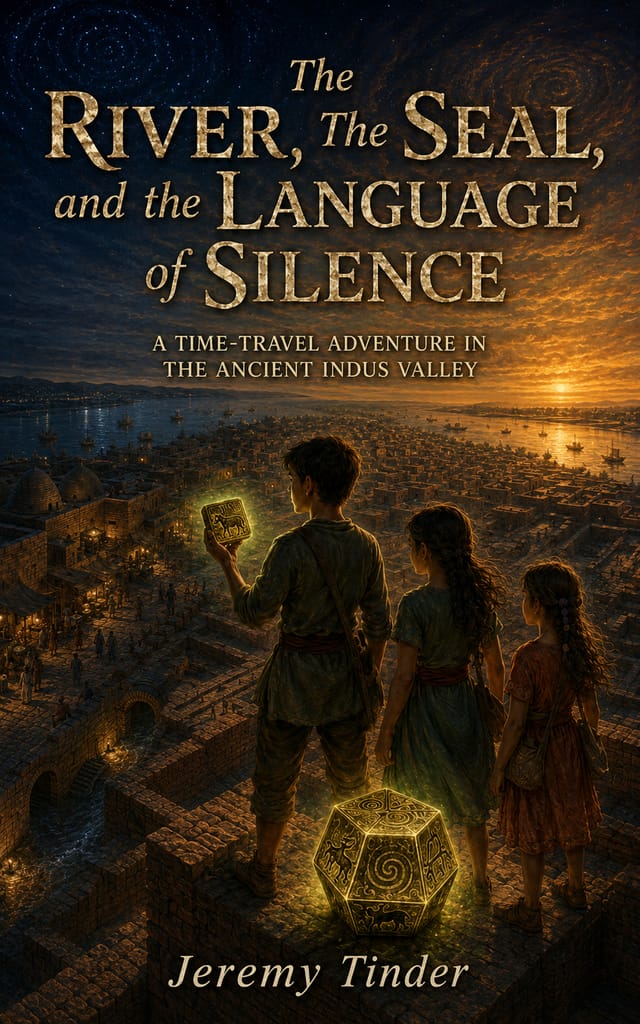
The River, The Seal, and The Language of Silence
A Time-Travel Adventure in the Indus Valley
Mohenjo-daro · Bronze Age, approximately 2600–1900 BC
The Carver children's magical nine-sided cube carries them to Mohenjo-daro in the ancient Indus Valley Civilization, where—now with their parents' full knowledge and blessing—they apprentice among master craftsmen and engineers and must learn the civilization's quietest lesson: that consistency, fairness, and unglamorous, careful work can matter more than noise or spectacle.
- Reading age8-12
- Length358 pages
- Series orderBook 3 of 15
- RegionIndus Valley (modern-day Pakistan and northwest India)
Get the book
Retailer links marked “coming soon” are placeholders until the official store links are published.
What readers will discover
- Indus Valley Civilization history and geography
- Mohenjo-daro's urban planning and standardized architecture
- ancient drainage and sanitation systems
- the undeciphered Indus script and seal-carving craft
- standardized weights, measures, and trade
- the Great Bath and early public sanitation
- cotton cultivation and early textiles
- granaries and food storage engineering
Main characters in this book
- Simeon Carver
- Eldest Carver child; a builder who apprentices with the city's drain-engineer
- Beckah Carver
- Middle Carver child; the family historian who learns to read the undeciphered Indus script
- Ellie (Eleanor) Carver
- Youngest Carver child; trains as a seal-carver and learns the discipline of stillness
- Daniel Carver
- Father; a carpenter/builder ('Pa') who recognizes the Indus Valley's engineering as kindred to his own craft
- Elizabeth Carver
- Mother; a Filipina homemaker ('Momma') who insists the family face the cube's journeys together
- Ravi
- Young apprentice drain-engineer who guides the Carver children through Mohenjo-daro
- Ashwin
- Master engineer who oversees the city's drainage system and tests Simeon's skills
- Devak
- Master seal-carver who takes in the Carver children and whose daughters become their teachers
- Mira
- Devak's older daughter; teaches Beckah to read the Indus script
- Priya
- Devak's younger daughter; teaches Ellie the craft of seal-carving
- Padma
- A healer in Mohenjo-daro who teaches lessons about cleanliness and medicine tied to the Great Bath
Themes & learning topics
Guidance for parents & educators
Clean, faith-affirming middle-grade adventure; mild peril (a flooded courtyard, references to disease risks from unclean water) but no graphic violence; brief mention of scares from a prior book's crocodile encounter; Christian faith and family devotion are present throughout, including Bible readings and prayer, but 'the Maker'/God is never depicted as a visible character.
Recommended reading age: 8-12.
Questions about this book
Spoiler-free answers, drawn from the book itself. Spoiler answers are clearly marked and tucked behind a click.
What civilization does this book visit?
The Carver children travel to Mohenjo-daro, a major city of the ancient Indus Valley Civilization, around 2600–1900 BC, in what is now Pakistan and northwest India.
#Do the parents know about the cube's travels in this book?
Yes. Unlike earlier books, Daniel and Elizabeth Carver now know the family's secret and choose to accompany their children to the shed and wait together while the children cross through time.
#Is this book appropriate for a sensitive child?
Yes, it is written for middle-grade readers with no graphic violence; the only tense moments involve a flooded courtyard and general references to disease from unclean water, handled in an educational, non-graphic way.
#What historical topics does this book teach?
It covers Indus Valley urban planning, standardized brick construction, citywide drainage and sanitation, the undeciphered Indus script, seal-carving, standardized weights and measures, granaries, and the Great Bath.
#Who are the main new characters the Carver children meet?
They meet Ravi, an apprentice drain-engineer; Ashwin, the master engineer who tests Simeon; Devak, a master seal-carver; his daughters Mira and Priya, who teach Beckah and Ellie their crafts; and Padma, a city healer.
#What does each Carver child learn or do in Mohenjo-daro?
Simeon apprentices with the city's drain engineer and repairs a real household drain; Beckah learns to read the ancient Indus script with Mira's help; Ellie trains as a seal-carver under Priya, learning patience and precision.
#Is the Indus script actually undeciphered in real history?
Yes—the real Indus script has never been deciphered by modern scholars, which the book uses as the basis for Beckah's storyline of learning to read it directly from the people who used it.
#Does the book portray God or 'the Maker' as a visible character?
No. Faith is present through the Carver family's prayers, Bible readings, and conversations about the 'Builder' behind the cube's curriculum, but the Maker is never shown or depicted directly.
#How does this book fit into the Cube Chronicles series order?
It is Book 3, following crossings to ancient Egypt and ancient Greece, and continues the family's journey along a thirty-four-destination spiral tied to a growing nine-sided cube.
#What is the title referring to?
The river is the Indus, whose floods shaped the valley; the seal refers to the carved stone seals bearing the Indus script; and the 'language of silence' reflects the book's theme that the civilization's quiet, unglamorous infrastructure—not monuments—was its truest form of expression.
#Is prior knowledge of Books 1 and 2 required to understand this book?
No, the book recaps key family history, but readers will appreciate returning references to Egypt and Greece more fully if they've read the earlier books.
#Does the book include any real archaeological sites or facts?
Yes, it draws on real features of Mohenjo-daro such as its citadel mound, the Great Bath, granary, standardized brick sizes, and its status as an undeciphered ancient script—dramatized through fictional characters and events.
#What happens at the end of the book regarding the family's larger mission?Spoiler
This answer reveals plot details.
In a hidden chamber reached through the city's drainage system, Simeon and Beckah decode a builders' message confirming that the curriculum spans thirty-four destinations over about eight and a half years, and that once the central 'lock' opens, 'the path does not close.'
#Does Ellie succeed at seal-carving by the end of the book?Spoiler
This answer reveals plot details.
Yes, after multiple failed and cracked attempts, Ellie completes her own seal under Priya's guidance, having learned to trade her usual boldness for the patience the craft demands.
#How does the book end and set up Book 4?Spoiler
This answer reveals plot details.
The Carver family celebrates New Year's Eve 1986 together, and Beckah reports the ninth face has already begun forming its fourth symbol, meaning a new crossing to a fourth civilization is expected within six to eight weeks.
#Reader questions & answers
No approved reader questions yet. Be the first to ask!
Ask a question about this book
Sign in or create a free account to ask a question. You never need an account to read.