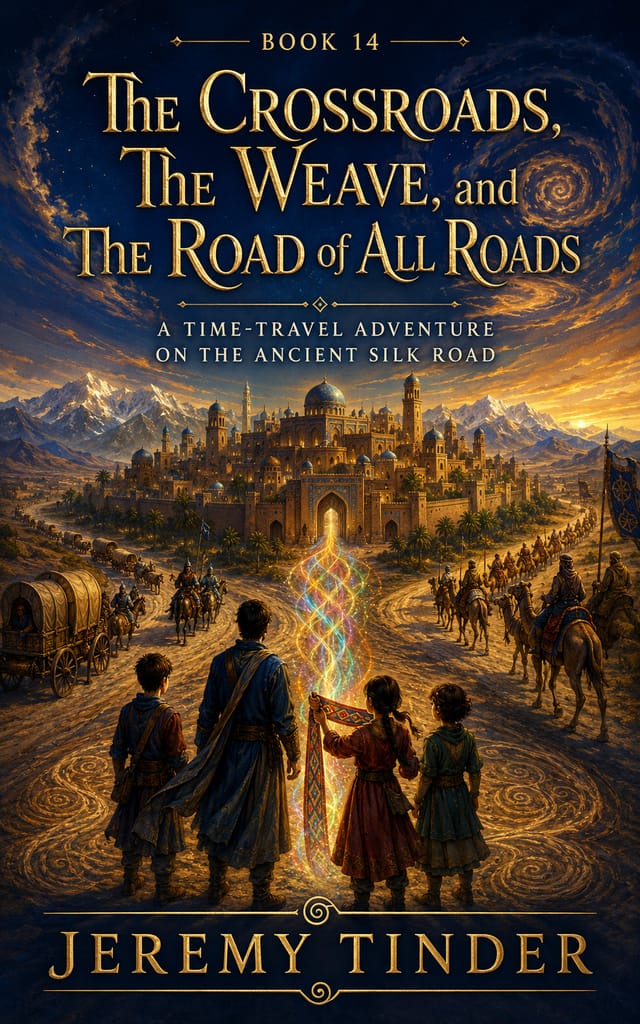
The Crossroads, The Weave, and The Road of All Roads
A Time-Travel Adventure on the Ancient Silk Road
A great Silk Road caravanserai city at the meeting of the trade roads · Ancient/medieval Silk Road era
The magical cube's fourteenth light is unlike any before it — not one color or two, but every color woven into a single patterned glow — and it carries the Carver family to a great Silk Road crossroads city, a caravanserai where trade routes and peoples from every direction meet and are 'woven' into one. There they apprentice with master weavers, dyers, and caravan-masters who teach them that a crossroads is richer than any single genius craft, while back home the family works up the courage to finally mend a twenty-six-year rift with Daniel's estranged brother, Uncle Ray.
- Reading age8-12
- Length170 pages
- Series orderBook 14 of 15
- RegionCentral Asia (ancient Silk Road)
Get the book
Retailer links marked “coming soon” are placeholders until the official store links are published.
What readers will discover
- Silk Road trade and caravanserais
- caravan-master leadership and mixed trade trains
- hand-weaving, looms, and carpet-making
- natural dyeing traditions
- oral and musical storytelling traditions of multicultural trade cities
- cross-cultural exchange along ancient trade routes
Main characters in this book
- Daniel Carver
- father, woodworker/builder, keeper of the family record shelf
- Elizabeth Carver
- mother, founder of the family's traditions
- Beckah
- eldest daughter, family record-keeper, awaiting college acceptances
- Ellie
- youngest, the family's singer
- Simeon
- son, builder/blacksmith apprentice
- Uncle Ray
- Daniel's estranged brother, reconciled during the book
- Zarina
- master weaver, ninth of the 'mothers of the inward arc,' keeper of the great carpet-of-record
- Rashid
- young caravan-master, mentor to Simeon
- Sanam
- dyer, mentor to Ellie
- Anahita
- loom-keeper, mentor to Beckah and Simeon
Themes & learning topics
Guidance for parents & educators
Themes of long-term family estrangement, a difficult sibling rift (business dispute, a parent's final illness, words said at a funeral) are discussed and ultimately reconciled; handled sensitively and resolved with confession and forgiveness. No graphic content; no violence beyond mention of a historical near-riot/mob fear at a city gate that is defused peacefully. Faith content includes prayer and a Scripture reading (Ephesians 1); the divine figure ('the Maker'/'the Weaver'/'the Gatherer') is referenced in prayer and metaphor but never depicted as visible.
Recommended reading age: 8-12.
Questions about this book
Spoiler-free answers, drawn from the book itself. Spoiler answers are clearly marked and tucked behind a click.
What is 'The Crossroads, The Weave, and The Road of All Roads' about?
It's Book 14 of The Cube Chronicles, in which the Carver family's magic cube shows them a light woven of every color at once and carries them to a great Silk Road crossroads city, where they learn from master weavers, dyers, and caravan-masters while working, back home, to heal a long family rift.
#Where and when is this book set?
The children travel to a bustling caravanserai city at a major junction of the ancient Silk Road, a crossroads where caravans, goods, and peoples from many nations gather and trade.
#Do I need to read the previous 13 books first?
The book stands alone as an adventure, but it pays off long-running family threads (the record shelf, Beckah's writing, Ellie's singing, Simeon's craftsmanship, and a family mystery about Uncle Ray) that build across the series, so reading in order gives the fullest experience.
#Who are the Carver children and what do they each learn in this book?
Beckah studies with the master weaver Zarina and learns to 'read' a carpet's woven history; Ellie apprentices with the dyer Sanam and learns the power of a unifying 'weaving voice' in song; Simeon apprentices with the caravan-master Rashid and learns to hold together a train of different, sometimes clashing, travelers and goods.
#Is the cube ever explained or shown to be operated by a visible being?
No. The cube's light and guidance are treated as a mysterious, unseen force tied to family faith; the Maker/Weaver is referenced in prayer and metaphor but is never depicted as a visible character.
#Is this book appropriate for younger middle-grade readers?
Yes, it is family-friendly with no graphic violence. The most mature material is emotional: a family works through decades of estrangement and hard feelings, handled with care and resolved through honesty and forgiveness.
#What historical topics does this book teach?
Readers learn about Silk Road trade routes, life in a caravanserai, the role of a caravan-master leading mixed trade trains, traditional hand-weaving and carpet-making, and natural dyeing techniques.
#Who is Uncle Ray, and why does he matter in this book?
Uncle Ray is Daniel Carver's estranged brother. A rift between them, dating back decades to a family dispute, has quietly shadowed the Carver household. This book's home storyline follows the family's decision to invite him back and repair the relationship.
#Does the book deal with real family conflict, and how is it resolved?Spoiler
This answer reveals plot details.
Yes. The Carvers confront a twenty-six-year silence between Daniel and his brother, stemming from disputes over their father's business and final illness. It is resolved through honest confession from both brothers and a family reunion, modeling healthy conflict resolution for young readers.
#What does the 'weaving voice' Ellie learns represent?
Sanam teaches Ellie that a unifying melody sung at moments of fear or division can help a frightened crowd feel like one people rather than turn against strangers — a lesson rooted in a story about a caravan nearly turned away from a city gate.
#Is there any romance or mature content in this book?
No romantic content. The book is centered on family relationships, craftsmanship, faith, and historical adventure, suitable for middle-grade readers.
#What happens with Beckah's college storyline?Spoiler
This answer reveals plot details.
Beckah receives college acceptance letters throughout the book and, by the end, chooses a school for its strength in writing and historical record-keeping — paralleling the book's themes of belonging and choosing where one's own 'thread' ties in.
#Does this book set up a fifteenth book in the series?
Yes. The family's woven record shows all fourteen threads tied except one final, central one, and a 'fifteenth tooth' is described as already growing, hinting at one more country and a final revelation to come.
#Is this a good book for a classroom studying the Silk Road?
Yes. It's well suited to a unit on Silk Road trade and cultures, offering an accessible, story-driven introduction to caravanserais, trade goods, weaving and dyeing crafts, and the diversity of peoples along the trade routes.
#How does the family's faith show up in this book?
The Carvers pray together, read Scripture (including Ephesians 1 on the gathering of all things), and interpret their adventure and their family reconciliation as part of a larger faith journey, without ever depicting God as a visible character.
#What is the significance of the title's three parts?
The Crossroads is the city where all roads meet; the Weave is the carpet-making and record-keeping craft the family learns; and the Road of All Roads reflects the deeper theme that a place gathering every path together is more valuable than any single, singular route.
#Reader questions & answers
No approved reader questions yet. Be the first to ask!
Ask a question about this book
Sign in or create a free account to ask a question. You never need an account to read.