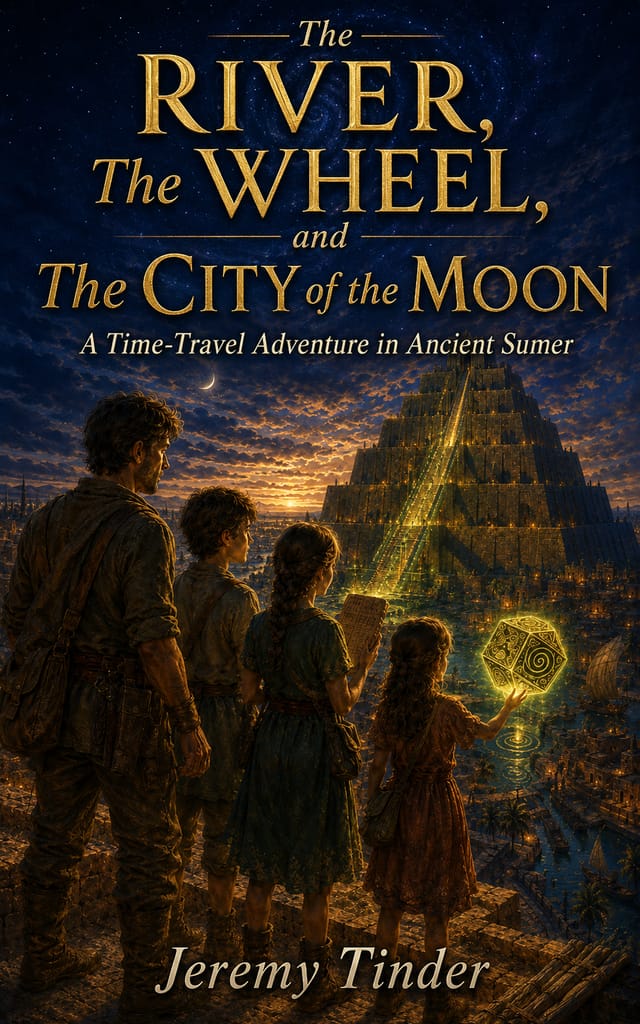
The River, The Wheel, and The City of the Moon
A Time-Travel Adventure in Ancient Sumer
Ur · Ancient Sumer, roughly the era of Abraham (early second millennium BC)
The magic cube's sixth configuration carries the Carver family to the mudbrick city of Ur in ancient Sumer, where they learn irrigation, bitumen-sealed building, cuneiform writing, and temple music from local friends and masters while uncovering the 'recursive' wisdom of building systems and people that keep building after you are gone.
- Reading age8-12
- Length198 pages
- Series orderBook 6 of 15
- RegionMesopotamia (the Tigris-Euphrates river delta, ancient Sumer, modern-day Iraq)
Get the book
Retailer links marked “coming soon” are placeholders until the official store links are published.
What readers will discover
- ancient Sumerian civilization and the Fertile Crescent
- irrigation canals and the shaduf water-lifting lever
- cuneiform writing and scribe schools (edubba)
- bitumen as mortar and waterproofing
- the true arch in mudbrick construction
- the Sumerian seeder plow
- ziggurats and Mesopotamian religion
- ancient Mesopotamian music (lyres) and the world's oldest notated hymns
- the biblical account of Abraham ('Ur of the Chaldees')
Main characters in this book
- Simeon Carver
- Eldest Carver child, now a seasoned builder's apprentice; learns canal-keeping, bitumen work, and the true arch from Igmil and Ur-Nin
- Beckah (Rebekah) Carver
- Family analyst and journal-keeper; deciphers Sumerian cuneiform and tracks the recursive 'sixth ring' pattern with her scribe friend Shara
- Ellie Carver
- Youngest Carver child and musician; learns the lyre from Dudu, a young temple musician
- Daniel Carver
- Father, master builder; teaches the sixth wisdom, 'build the builder,' and receives Ur-Nin's reed water-level
- Elizabeth Carver
- Mother; packs and provisions each crossing and voices the family's 'feed them well' doctrine
- Igmil
- Sumerian canal-master's apprentice who teaches Simeon irrigation, bitumen, and reed-boat building
- Ur-Nin
- Sumerian canal-master, Igmil's teacher, who gives Simeon and Daniel the sixth wisdom's central lesson and a reed water-level
- Shara
- A Sumerian girl secretly teaching herself to write outside the scribe school (edubba); becomes Beckah's friend
- Dudu
- A ten-year-old temple lyre player who teaches Ellie to play melody, rhythm, and harmony together
Themes & learning topics
Guidance for parents & educators
Family-friendly historical adventure; includes brief in-story Christian devotional reflection tied to the biblical Abraham/Ur connection; no graphic violence; mild peril from river/canal work and manual labor injuries (tar burns); the Maker/divine presence is referenced in prayer but never shown.
Recommended reading age: 8-12.
Questions about this book
Spoiler-free answers, drawn from the book itself. Spoiler answers are clearly marked and tucked behind a click.
What civilization does Book 6 visit?
The Carver family travels to ancient Sumer, in the city of Ur on the Tigris-Euphrates river delta, home to some of the world's first cities.
#Is this book part of a series, and do I need to read the others first?
Yes, it is Book 6 of The Cube Chronicles. It can be read as a standalone adventure, but returning readers will recognize ongoing family traditions and callbacks to earlier crossings (Egypt, the Indus Valley, China, Japan, and more).
#Who are the main characters?
The Carver family: Daniel (a builder), Elizabeth (mother), and their children Simeon, Beckah, and Ellie. In Sumer they befriend Igmil (a canal apprentice), Ur-Nin (a canal-master), Shara (a self-taught scribe girl), and Dudu (a young temple musician).
#What is the 'sixth configuration' of the cube?
It's the cube's green-gold, rippling glow that signals the family's sixth destination—a river-delta civilization built around irrigation, distinct from the fire, water, and light patterns of prior crossings.
#What historical topics does this book teach?
Readers learn about Sumerian irrigation (canals, the shaduf), cuneiform writing and scribe schools, bitumen as a building material, the true arch, the seeder plow, ziggurats, and ancient Mesopotamian music.
#Is the book appropriate for a classroom or library collection?
Yes. It is a family-friendly, middle-grade historical adventure with strong educational content on ancient Mesopotamia, suitable for classroom units on early civilizations or library shelves alongside other historical fiction.
#Does this book contain any violence or scary content?
No graphic violence. There is everyday manual-labor peril (working near rivers and canals, tar burns from bitumen work) typical of historical craft apprenticeship, handled in a mild, age-appropriate way.
#Is there religious content in this book?
Yes. As in the rest of the series, the Carver family is a Christian family who prays and reflects on faith. This volume ties their visit to Ur directly to the biblical account of Abraham, who is said to have come from 'Ur of the Chaldees.'
#What is 'the Maker' and is it shown in the book?
References to a divine Maker/God appear in the family's prayers and reflections throughout the series, but the Maker is never depicted or shown visibly on the page.
#What craft does Simeon learn in this book?
Simeon apprentices in Sumerian canal-keeping and water management, learning to work with bitumen (natural tar) as mortar and waterproofing, build reed boats, and construct a true mudbrick arch.
#What does Ellie learn in Ur?
Ellie learns to play the lyre from a young temple musician named Dudu, discovering how one instrument can carry melody, rhythm, and harmony together.
#What is the 'sixth wisdom' the father teaches in this book?
Daniel's sixth building wisdom is 'build the builder'—teaching an apprentice so that what you build outlives you, mirrored in the recursive, self-sustaining systems (canals, seed crops) the family studies in Sumer.
#How long is the book, and how many chapters and parts does it have?
The River, The Wheel, and The City of the Moon runs about 52,000 words (198 pages in paperback), organized into 30 chapters across four parts: The Delta, The Wheel, The Deep, and The Return.
#Does this book end on a cliffhanger?
It closes on the family's usual grateful, reflective return home, but ends with a clear hint that a seventh cube configuration ('tooth') is already forming, setting up the next book in the series.
#What happens to Shara, the scribe girl Beckah befriends?Spoiler
This answer reveals plot details.
Shara, who had been secretly teaching herself cuneiform outside the scribe school walls, gives Beckah a keepsake tablet and a cylinder seal that the Carver family brings home and displays on their shelf, and Beckah continues corresponding with her through the visit.
#Does the family encounter anything connected to the biblical Abraham?Spoiler
This answer reveals plot details.
Yes—the family realizes they are visiting Ur during the era associated with Abraham's family, and Daniel reflects at length in prayer on the biblical 'Get thee out' call, though Abraham himself does not appear as a character on the page.
#What keepsakes do the Carvers bring home from Sumer?Spoiler
This answer reveals plot details.
They return with a fired brick stamped in cuneiform with the family's names, Shara's practice tablet, and a cylinder seal, all added to the family's growing 'shelf' of relics from each civilization.
#Reader questions & answers
No approved reader questions yet. Be the first to ask!
Ask a question about this book
Sign in or create a free account to ask a question. You never need an account to read.