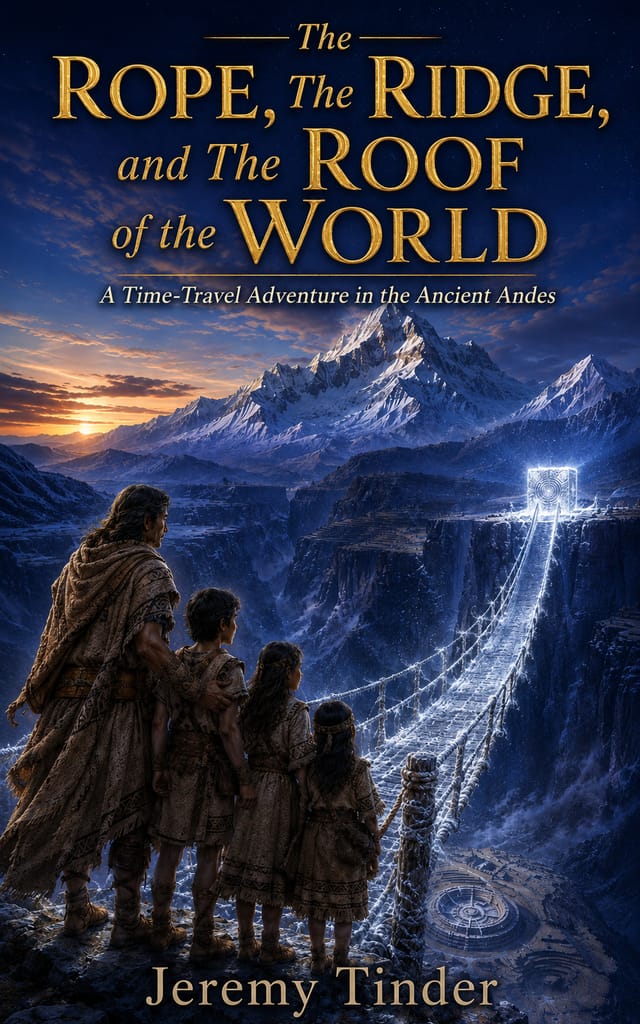
The Rope, The Ridge, and The Roof of the World
A Time-Travel Adventure in the Ancient Andes
A terraced mountain village in the high Andes, reached by rope bridge · Pre-Columbian Andes (Inca period)
The seventh configuration of the mysterious cube glows with a hard, snow-bright silver light, sending the Carver family to a terraced village high in the ancient Andes. There, thin air, altitude sickness, and the ever-present threat of the mountain test the family as Simeon apprentices under a rope-mistress to learn the demanding, unforgiving craft of cable-making for the village's suspension bridge.
- Reading age8-12
- Length175 pages
- Series orderBook 7 of 15
- RegionSouth America (Andean highlands, ancient Inca-era civilization)
Get the book
Retailer links marked “coming soon” are placeholders until the official store links are published.
What readers will discover
- Andean/Inca rope-bridge engineering
- khipu (quipu) knotted-cord record-keeping
- high-altitude adaptation and survival
- terrace farming and the potato's role in Andean life
- village social structure and communal labor
- llamas and alpacas in Andean daily life
Main characters in this book
- Simeon Carver
- Eldest son, now a journeyman craftsman who apprentices under a rope-mistress to learn cable-making
- Beckah Carver
- Family scribe/decoder who reads the cube's configurations and keeps the record of what the family learns
- Eleanor 'Ellie' Carver
- Youngest daughter, musical and eager, drawn to the wonder of snow and the mountain heights
- Elizabeth Carver
- Mother, who manages logistics, altitude precautions, and shares a bond with a village elder over shared grief and resilience
- Daniel Carver
- Father and builder, who articulates the seventh family 'wisdom' about building bridges before they're needed
- Mama Quri
- The village's rope-mistress, keeper of the suspension bridge's cables and its lore
- Illa
- Villager who introduces Simeon to Mama Quri and the community
- Sami
- A khipu-keeper who explains how knotted cords record memory and truth
Themes & learning topics
Guidance for parents & educators
Includes a village boy's off-page death from altitude-related illness/accident, handled sensitively with grief processed through community and faith; no graphic violence; themes of hardship at altitude are age-appropriate for middle grade.
Recommended reading age: 8-12.
Questions about this book
Spoiler-free answers, drawn from the book itself. Spoiler answers are clearly marked and tucked behind a click.
What civilization does Book 7 take the Carver family to?
The family travels to a terraced village high in the ancient Andes, in a civilization organized around rope-bridge engineering and altitude survival, evoking the Inca era.
#Do I need to read the previous six books to understand this one?
No. Each Cube Chronicles book stands alone with a new destination, though returning readers will recognize the Carver family's ongoing traditions and the developing pattern of the cube's configurations.
#What craft does Simeon learn in this book?
Simeon apprentices under Mama Quri, the village's rope-mistress, to learn cable-making for the suspension bridge — a demanding trade of sustained tension and endurance, different from the trades (stonework, metalwork) he's learned in prior books.
#Is this book appropriate for a classroom read-aloud?
Yes. It is written for middle-grade readers with family-friendly content, though it includes a sensitively handled off-page death from an altitude-related accident, which teachers may want to preview.
#What historical or cultural topics does the book teach?
Readers learn about Andean rope-bridge construction, khipu (knotted-cord) record-keeping, terrace farming, the potato's importance to Andean civilization, and the challenges of living at high altitude.
#Who is Mama Quri?
Mama Quri is the village's rope-mistress, the keeper who judges, maintains, and directs the rebuilding of the community's suspension bridge cables, and who mentors Simeon.
#Does 'the Maker' (the cube's origin) appear directly in this book?
No. As in the rest of the series, the Maker is never shown directly; the family experiences the cube's guidance and meaning through configurations, symbols, and reflection rather than any visible appearance.
#What is a khipu, and how is it used in the story?
A khipu is a knotted cord used by Andean civilizations to record numbers and information. In the book, a keeper named Sami explains that the khipu 'remembers' truthfully what people might forget or misstate.
#How does the family cope with high altitude in the story?
Elizabeth insists the family pace themselves, rest often, drink more water, and pack warm layers and eye protection, since altitude sickness brings headaches, fatigue, and shortness of breath that ease only with time.
#What is the family's seventh 'wisdom' or lesson in this book?
Daniel's lesson is 'Build the bridge before you need to cross' — the idea that meaningful support and preparation must be built ahead of time, out of love, before the need for it ever arrives.
#Is the series religious?
The books include gentle expressions of Christian faith through the Carver family's evening prayers and reflections, woven into the adventure and historical learning rather than presented as overt teaching.
#What age group is this book written for?
The Cube Chronicles is written for middle-grade readers, generally ages 8 to 12, and is suitable for family read-aloud.
#How long is this book?
The Rope, The Ridge, and The Roof of the World is approximately 49,771 words and 175 pages in the KDP paperback edition.
#Does a character die in this book?Spoiler
This answer reveals plot details.
Yes — a village boy dies from an altitude-related cause partway through the story. His death is handled with care through community mourning and Mama Quri's reflections on grief and endurance, without graphic detail.
#What does the family discover about the cube's larger pattern in this book?Spoiler
This answer reveals plot details.
They realize the builders across history are not people traveling toward a distant destination but are themselves becoming spans of one endless bridge woven across time, meaning there is 'no far side' left to reach — only more of the bridge to build.
#How does Elizabeth's personal history connect to the village elder Mama Quri?Spoiler
This answer reveals plot details.
Elizabeth recognizes her own experience of carrying grief and responsibility after her mother's death in Mama Quri's teaching that grief and work must be twisted together, like cable, to hold weight that would otherwise break a person.
#Reader questions & answers
No approved reader questions yet. Be the first to ask!
Ask a question about this book
Sign in or create a free account to ask a question. You never need an account to read.