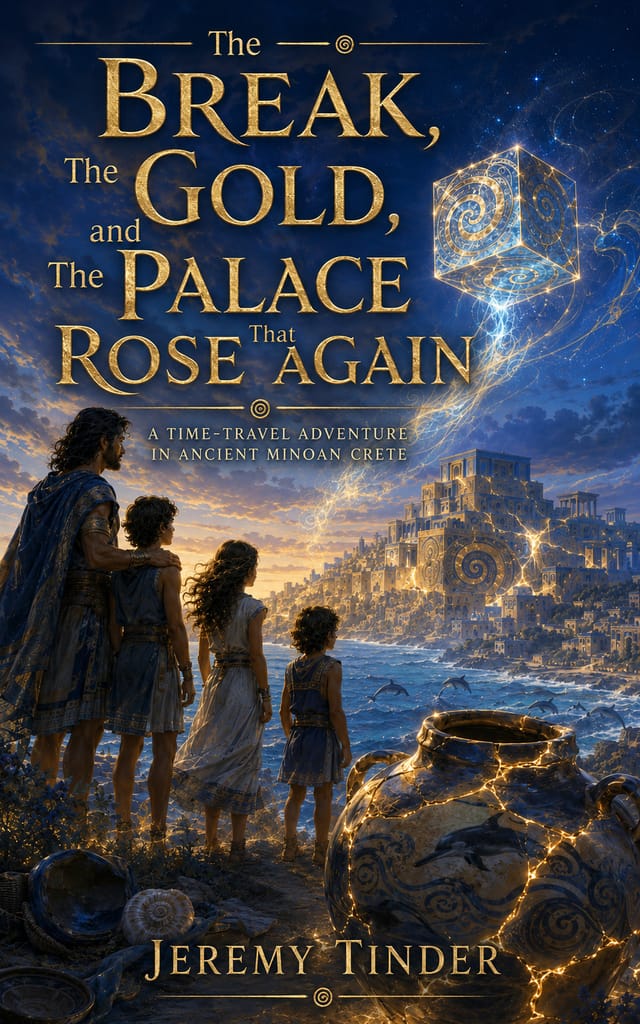
The Break, The Gold, and The Palace That Rose Again
A Time-Travel Adventure in Ancient Minoan Crete
An unwalled Bronze Age harbor town and its rising palace-complex, on an island of terraced hillsides, peak-shrines, and a mountain mending-cave · Bronze Age Aegean, Minoan civilization
On their eleventh cube crossing, the Carver children arrive on a wealthy, entirely unwalled Minoan island where earthquakes are routine and nothing is hidden when it breaks — pottery, walls, and murals are deliberately repaired with visible seams of gold. As Simeon apprentices with master menders and builders, and Beckah and Ellie uncover the island's archive and reconciliation songs, the family learns the crossing's culminating wisdom: build things (and people, and families) not to be unbreakable, but to be mended — and that a repaired crack can be more beautiful than an unbroken thing ever was.
- Reading age9-12 (middle grade)
- Length172 pages
- Series orderBook 11 of 15
- RegionAncient Minoan Crete (Aegean)
Get the book
Retailer links marked “coming soon” are placeholders until the official store links are published.
What readers will discover
- Minoan Crete: unfortified cities, palace architecture, and earthquake-resilient building
- kintsugi-style gold-seam pottery and mural repair as a real historical/craft tradition
- Bronze Age archives and clay tablet record-keeping
- Aegean daily life: drainage, frescoes, peak sanctuaries, terraced agriculture
- earthquake engineering concepts (flexible framing, deliberate load-testing)
- the Second Corinthians theme of the 'ministry of reconciliation'
Main characters in this book
- Beckah
- eldest sibling and family chronicler, thirteen-going-fourteen-year-old keeper of the eleventh field notebook
- Simeon
- eldest child and aspiring builder/engineer, about to leave for engineering school; apprenticed this crossing to a master mender
- Ellie
- thirteen-year-old musician sibling who reads each country through sound and song
- Daniel
- the children's father, a craftsman/builder who receives an annual 'wisdom' each crossing
- Elizabeth (Celyn)
- the children's mother, who names unspoken truths and hosts the family's reconciling meals
- Sepa
- a master mender who teaches Simeon the gold-seam repair craft (kintsugi-like pottery mending) and its lessons about breaking well
- Ida
- keeper of the island's clay-tablet archive, who tends both 'honored' mended records and a 'dark shelf' of not-yet-mendable ones
- Turi
- a thirteen-year-old singer who mends broken work-songs by finding the reconciling note between clashing voices
- Rhaya
- the island's oldest mural-mender, who reads Simeon's hands and prepares him for a coming personal break
- Deukos
- a master builder who rebuilds the palace hall to flex, crack at chosen seams, and be gilded rather than break catastrophically
Themes & learning topics
Guidance for parents & educators
Family-friendly with mild real-world peril from earthquakes and tremors; themes of grief, familial estrangement, and a pastor's candid testimony about past alcoholism and personal failure, handled discreetly; a young adult character permanently leaving home for college is treated with age-appropriate emotional weight; light Christian faith content including sermon and Scripture discussion; no graphic violence.
Recommended reading age: 9-12 (middle grade).
Questions about this book
Spoiler-free answers, drawn from the book itself. Spoiler answers are clearly marked and tucked behind a click.
Is 'The Break, The Gold, and The Palace That Rose Again' part of a series?
Yes. It is Book 11 of The Cube Chronicles by Jeremy Tinder, a middle-grade series following the Carver family as a mysterious cube transports them through different eras of history.
#Do I need to read the earlier ten books first?
It helps but isn't required. Book 11 recaps the family's ongoing traditions (the field notebook, the annual 'wisdom,' the map with prior countries marked), so new readers can follow along, though longtime readers will catch more callbacks to earlier crossings.
#What historical setting does this book explore?
The Carver children travel to ancient Minoan Crete during the Bronze Age, visiting an unwalled harbor town and a great palace-complex known for its frescoes, drains, and earthquake-prone terrain.
#Who are the Carver family members in this book?
Beckah (the notebook-keeping eldest daughter), Simeon (the eldest, an aspiring builder about to leave for engineering school), Ellie (the musical thirteen-year-old), and their parents Daniel and Elizabeth.
#What is the central idea or theme of this book?
The book explores the idea that things — pottery, buildings, songs, and families — are not meant to be unbreakable, but meant to be mended, and that a repaired break, made visible rather than hidden, can be more beautiful than the original.
#Is this book appropriate for a sensitive 9-year-old?
Generally yes. It is family-friendly with no graphic content, though it includes a pastor's honest account of a past struggle with alcoholism and touches on grief and a teenager leaving home, all handled with care and warmth.
#Does the cube itself ever get explained in this book?
No. Consistent with the series, the cube's workings and the unseen 'Maker' behind the family's journeys are never fully explained or shown directly; the mystery continues to unfold gradually across the series.
#What real historical or craft traditions does the book teach?
It introduces readers to Minoan architecture and city planning, ancient clay tablet archives, and a gold-seam pottery and mural repair tradition (similar to real-world kintsugi) as a lens for talking about mending broken things.
#Is there religious content in this book?
Yes. As in prior installments, the family reads Scripture together and a local pastor delivers a sermon connecting the island's mending culture to the Christian idea of Christ's resurrected, scarred body; the content is presented gently within a family devotional frame.
#How does this book handle earthquakes and disaster?
Tremors and past earthquakes are discussed frequently since the island's whole culture is built around living with and rebuilding after them, but the depictions are non-graphic and framed around resilience and craftsmanship rather than disaster horror.
#Would this book work well for a classroom or homeschool unit on ancient civilizations?
Yes. It offers an engaging introduction to Minoan Crete's architecture, trade, and artistic traditions, along with discussion-friendly themes about repair, reconciliation, and resilience that pair well with history or character-education units.
#Is this a standalone story or does it end on a cliffhanger?
The core Minoan adventure and its lessons resolve by the end of the book, but the overarching family story continues, with hints that the family is nearing the center of a larger mystery tied to the map they've been building across all eleven crossings.
#What happens with Simeon by the end of the book?Spoiler
This answer reveals plot details.
Simeon completes his apprenticeship in the island's mending and building crafts and, at the story's close, leaves home for engineering school, becoming the first Carver child to move out — a change the family deliberately marks and honors rather than hides.
#What is revealed about who has been secretly maintaining the island's ancient mending sites?Spoiler
This answer reveals plot details.
Beckah discovers that the cave chambers and gilded repairs have been continuously tended for far longer than any civilization the family has visited, by unseen caretakers who appear to already know the family is coming and are deliberately staying out of sight to prepare a welcome.
#Does the family experience a real earthquake or major crisis during the crossing?Spoiler
This answer reveals plot details.
The book focuses more on the island's culture of repair and its rebuilt, earthquake-tested palace hall than on depicting an active catastrophic quake during the family's stay; tension comes mostly from tremors, historical rebuilding stories, and emotional family stakes rather than an on-page disaster sequence.
#Reader questions & answers
No approved reader questions yet. Be the first to ask!
Ask a question about this book
Sign in or create a free account to ask a question. You never need an account to read.