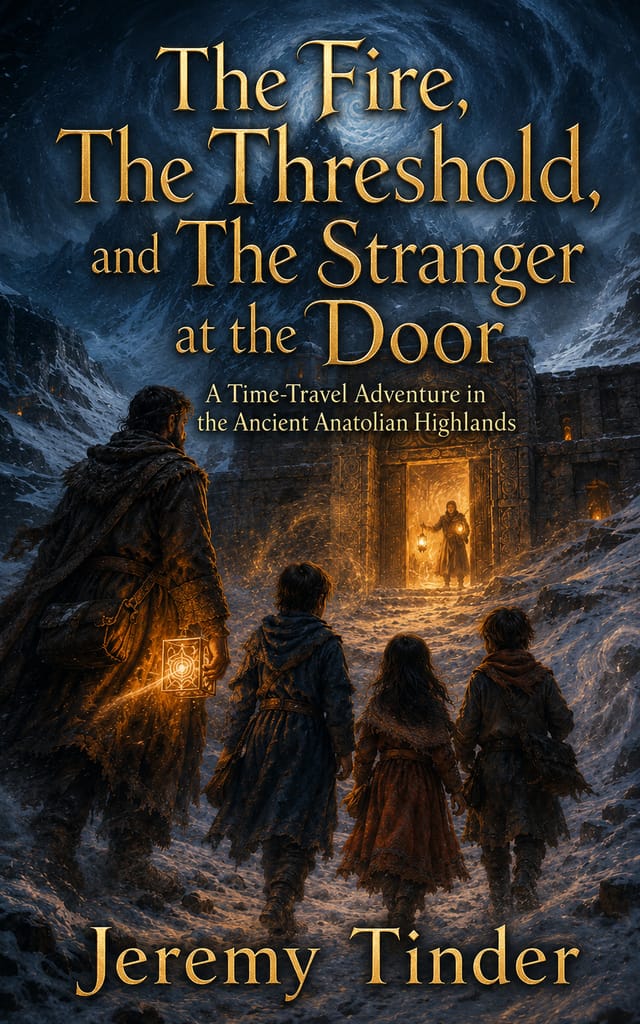
The Fire, The Threshold, and The Stranger at the Door
A Time-Travel Adventure in the Ancient Anatolian Highlands
A mountain caravanserai and its town, with a shed workshop and farmhouse in Carolina as the frame story · Ancient Anatolia, roughly Bronze Age / Hittite-era highlands, framed against a present-day family story
On their tenth crossing, the Carver children follow a flickering, fire-like light through the cube into the cold mountain highlands of ancient Anatolia, where they nearly freeze on the road before being taken in by a caravanserai built entirely around welcoming strangers — and there they learn the deepest lesson of the whole journey: that a home is not its walls but its open door.
- Reading age8-12
- Length174 pages
- Series orderBook 10 of 15
- RegionAncient Anatolian highlands (a Hittite-inspired mountain pass and guest-hall) and the Carver family's home in the Carolinas
Get the book
Retailer links marked “coming soon” are placeholders until the official store links are published.
What readers will discover
- ancient Anatolian/Hittite-inspired hospitality codes and guest-right
- cuneiform-style wedge-tablet writing and law
- caravanserai architecture and threshold design
- hearth-keeping traditions and fire as communal memory
- oral versus written law across generations
- comparative review of the writing systems from all nine prior civilizations
Main characters in this book
- Beckah Carver
- family historian and scribe, tracks the tenth civilization's writing system and guest-law across her tenth notebook
- Ellie Carver
- twelve-year-old singer who learns the caravanserai's welcome-songs, especially the song for those who don't believe they're wanted
- Simeon Carver
- seventeen-year-old builder who studies threshold architecture and learns to be a guest, not only a host
- Daniel Carver
- the children's father, a builder back home who receives the family's tenth 'wisdom' about building doors wider than needed
- Elizabeth Carver
- the children's mother, keeper of the household's unwritten guest-law and an always-empty extra chair
- Kubaba
- the town's elderly hearth-mother, keeper of a fire that has never gone out for a thousand years
- Sappi
- fifteen-year-old law-keeper's daughter who presses the ancient guest-law into clay tablets
- Halki
- twelve-year-old hearth-child who teaches Ellie the caravanserai's welcome-songs
- Tarhun
- builder who teaches Simeon that a threshold's strength lies in being wide and open, not defended
Themes & learning topics
Guidance for parents & educators
Family-friendly middle-grade adventure with a strong Christian faith thread (prayers, Scripture references including the Law of Moses, cities of refuge, and the Gospel) woven into the historical lessons; a life-threatening winter storm early on creates real peril but no graphic violence; themes of enemies, old grudges, and a stable-boy orphan's quiet loneliness are handled gently and resolve with comfort and belonging.
Recommended reading age: 8-12.
Questions about this book
Spoiler-free answers, drawn from the book itself. Spoiler answers are clearly marked and tucked behind a click.
What is the exact title of book 10 in The Cube Chronicles?
The Fire, The Threshold, and The Stranger at the Door, with the descriptor 'A Time-Travel Adventure in the Ancient Anatolian Highlands,' both confirmed in the manuscript's front matter.
#Where and when does this installment take place?
The children cross into the ancient Anatolian highlands, arriving in a bitter winter at a mountain caravanserai (guest-hall) and its town, a setting inspired by ancient hospitality codes such as those recorded on Hittite-era law tablets.
#Do I need to read the first nine books to understand this one?
No, the crossing and setting stand on their own, but Beckah's running study of writing systems and the family's 'wisdoms' build on lessons from earlier books, so longtime readers will notice deeper callbacks and payoffs.
#Who are the main characters in this book?
The three Carver children — Beckah (the family's historian and scribe), Ellie (age twelve, a singer), and Simeon (age seventeen, a builder) — along with their parents Daniel and Elizabeth back home, and new highland friends Kubaba, Sappi, Halki, and Tarhun.
#What is the cube and how does it work in this book?
The cube is the family's time-travel device; this time its light behaves differently from the nine before it, flickering and moving like firelight glimpsed through a doorway rather than glowing steadily, signaling a country built around welcome rather than distance.
#Is this book scary or intense for younger readers?
There is real tension in an early scene where the children face a life-threatening winter storm on a mountain road, but the danger resolves quickly into rescue and warmth, and the book overall centers on comfort, hospitality, and belonging rather than danger.
#Does the book show 'the Maker' or explain who built the cube?
No. Consistent with the whole series, the Maker behind the cube's power is never depicted or shown directly; the book focuses on the mystery of the light and the wisdom the family gathers from each crossing.
#What historical topic does Beckah study in this installment?
Beckah completes her decade-long study of ancient writing systems by examining the highland town's wedge-pressed law tablets, which record a strict guest-law protecting travelers — the capstone to comparisons she has drawn since Egypt in book one.
#What does Ellie learn from the character Halki?
Ellie learns the caravanserai's welcome-songs, a musical tradition sung to strangers at the door to calm their fear, including the hardest one: a song for guests who don't believe they deserve to be welcomed.
#What life lesson or family 'wisdom' does this book center on?
The tenth wisdom Daniel discovers is to 'build the door wider than you think you need' — that true strength and legacy come from keeping a home open to those who haven't arrived yet, not from building it more closed and defended.
#Is this book appropriate for a classroom or homeschool history unit?
Yes. It works well alongside units on ancient Near Eastern/Anatolian civilizations, cuneiform writing, and hospitality codes such as those found in Hittite law and biblical guest-right traditions, with in-story comparisons across nine other ancient writing systems.
#Does this book have religious content?
Yes, as in prior installments, the Carver family's Christian faith is woven throughout, including references to Scripture such as the Law of Moses, the cities of refuge, and Gospel parallels to the guest-law the children learn abroad.
#How long is the book and is it a quick read for a middle-grade reader?
The manuscript runs about 51,600 words across 30 chapters in four parts, corresponding to a 174-page paperback — consistent with the length of the earlier Cube Chronicles books.
#Who is the stable-boy character, and why does he matter to the story?Spoiler
This answer reveals plot details.
He is an orphan who works the caravanserai's stables and, despite living in the warm hall for years, has never felt he truly belongs there; Ellie's realization that he needs the 'you are wanted' welcome-song more than any stranger at the door becomes the emotional turning point of her training.
#What is revealed about Kubaba's ancient fire and the message carved around it?Spoiler
This answer reveals plot details.
The fire has burned unbroken for a thousand years, tended by an unbroken chain of keepers; carved words around it, which Kubaba could never read, turn out to say the stranger at the threshold is the guest the fire was built for — and Beckah reading them aloud convinces Kubaba the children are the very guests the ancient builders were waiting for.
#How does the book end, and does it set up book eleven?Spoiler
This answer reveals plot details.
The family returns home carrying a coal from the ancient fire to keep burning in their own stove, Elizabeth reveals the meaning behind her family's twenty-year tradition of an always-set empty chair, and the story closes with the eleventh cube light already beginning to grow in the shed, promising a new crossing ahead.
#Reader questions & answers
No approved reader questions yet. Be the first to ask!
Ask a question about this book
Sign in or create a free account to ask a question. You never need an account to read.