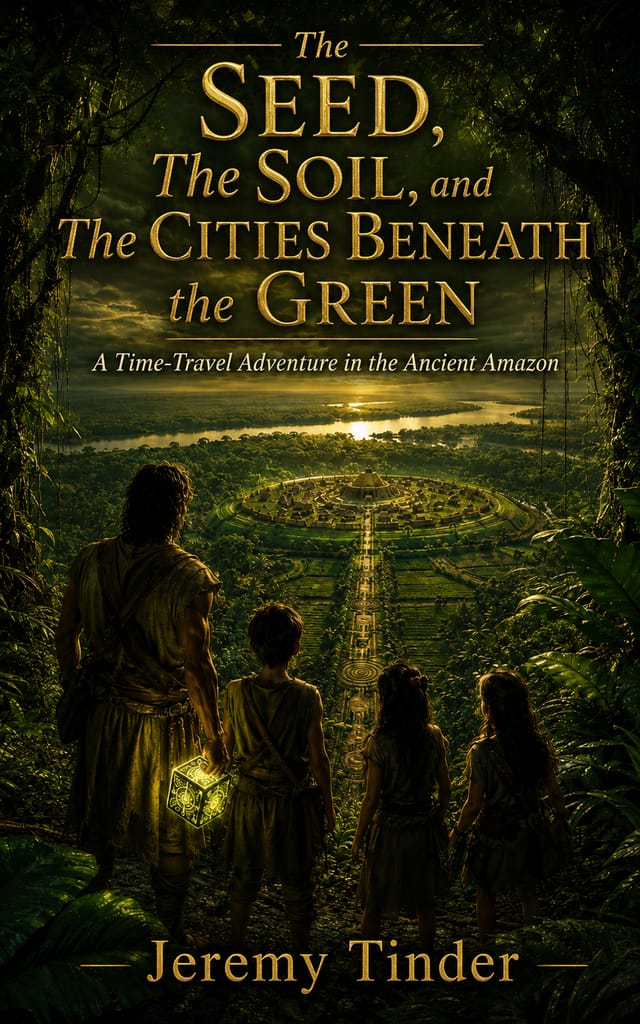
The Seed, The Soil, and The Cities Beneath the Green
A Time-Travel Adventure in the Ancient Amazon
An Amazonian food-forest civilization of raised causeways, ring-villages, fish weirs, and manufactured black-earth (terra preta) soil · A precolumbian Amazonian society built up over roughly four thousand years of continuous forest-tending
On their eighth crossing, the Carver children follow the cube's green-gold-and-black configuration down from the Andes into a vast Amazonian rainforest that turns out to be one enormous, invisible, four-thousand-year-old city — a food forest of raised roads, fish weirs, and hand-made black soil tended by thirty thousand dispersed people who left no monuments and no writing, only a living, growing world.
- Reading age8-12
- Length174 pages
- Series orderBook 8 of 15
- RegionAncient Amazon rainforest, South America
Get the book
Retailer links marked “coming soon” are placeholders until the official store links are published.
What readers will discover
- Amazonian terra preta (anthropogenic black earth) and ancient soil science
- precolumbian Amazonian food forests and raised-road causeways
- dispersed, non-hierarchical urban settlement patterns
- fish weir engineering and seasonal flood-farming
- oral knowledge transmission without writing systems
- ecological reciprocity and closed-loop waste use
- Brazil-nut groves and human-shaped 'wild' forest
Main characters in this book
- Simeon Carver
- Eldest son and the family's builder; apprentices to forest-tender Iara and forest-mother Tapira and learns to 'feed' rather than 'finish'
- Beckah Carver
- Cube-reader and family chronicler; decodes the eighth configuration and records the living, moss-grown map in the flooded cave
- Ellie Carver
- Youngest child; learns to hear the forest's layered birdsong and find her own 'slot' in it, guided by a girl named Yara
- Daniel Carver
- Father, a builder by trade, who receives the crossing's eighth wisdom, 'Tend what you plant,' and reframes his life's work around it
- Elizabeth Carver
- Mother who sends the children off carrying garden seeds for the first time and whose lifelong motto, 'the feeding is structural,' becomes the book's central lesson
- Iara
- Young forest-tender who teaches Simeon how black earth (terra preta) is made from char, bone, and waste, and how it keeps growing if fed
- Tapira
- The village's forest-mother and eldest seed-keeper, who survived a great sickness by planting through her grief and gives Simeon a gift of living dark earth
- Coema
- Village girl who tends the seed library and explains to Beckah how the forest-people make decisions without rulers
- Yara
- Girl who teaches Ellie to listen for the forest's 'song' and the place a human voice can take within it
Themes & learning topics
Guidance for parents & educators
References a historical fever epidemic that killed a third of a village, including a character's husband and both sons (discussed briefly, not depicted); a flooded underground cave sequence involves tense wading in near-dark water; themes of grief and loss handled gently. No violence, no romance, no on-page death; the divine ('the Maker'/God) is discussed and prayed to but never shown or depicted visibly, consistent with series convention.
Recommended reading age: 8-12.
Questions about this book
Spoiler-free answers, drawn from the book itself. Spoiler answers are clearly marked and tucked behind a click.
What civilization does Book 8 take the Carver family to?
An ancient Amazonian rainforest civilization — a dispersed, four-thousand-year-old 'food forest' city of raised causeways, fish weirs, and manufactured black-earth soil, home to roughly thirty thousand people living without a central settlement or writing system.
#Do the Carver children travel together in this book?
Yes. As in every Cube Chronicles book, Simeon, Beckah, and Ellie Carver travel together through the cube, each focusing on different lessons of the crossing while their parents, Daniel and Elizabeth, support them from home.
#What is 'terra preta' and why does it matter in this story?
Terra preta, or 'black earth,' is a real-world type of rich, human-made Amazonian soil created over generations from charcoal, bone, ash, and food waste. In the book, Simeon apprentices under a forest-tender named Iara to learn how this living soil is made and fed, and it becomes the story's central symbol of tending versus finishing.
#What is the 'eighth wisdom' Daniel Carver receives this crossing?
'Tend what you plant.' Unlike the previous seven wisdoms, which were all about building well, this one is about caring for a finished thing so it stays alive — introducing the book's theme that a made thing left unattended eventually dies.
#Is this book part of a series, and do I need to read the others first?
It's Book 8 of The Cube Chronicles. Each book is a self-contained historical adventure, though returning readers will recognize the ongoing 'wisdom' and 'warning' threads that build across the series.
#Is the story appropriate for sensitive young readers?
Yes, with light caveats. It's family-friendly and free of violence or romance, but it does reference a historical epidemic that took a character's husband and sons (mentioned, not shown) and includes a tense scene of wading through a flooded cave. Themes of grief are handled with warmth and hope.
#Does the cube ever explain who built it or who 'the Maker' is?
The family continues to wonder about the builders behind the cube and its chambers, and they draw spiritual parallels to their faith, but neither the cube's makers nor the divine figure they discuss is ever shown or physically depicted — the mystery remains open by design.
#What real historical/scientific ideas does this book teach?
It introduces real archaeological findings about precolumbian Amazonia: engineered 'dark earth' soils, raised causeway roads, managed food forests, fish weir systems, and evidence that the Amazon supported large, sophisticated, non-urban-in-the-traditional-sense populations without stone monuments or writing.
#How does this book fit into a classroom or homeschool unit on ancient civilizations?
It works well alongside units on the Amazon, agricultural history, or ecology, since it dramatizes real anthropological findings about Amazonian soil science and settlement patterns in an accessible narrative, paired with discussion-ready themes about community and stewardship.
#Does Ellie's storyline focus on something specific this time?
Yes. Guided by a village girl named Yara, Ellie learns to listen for the forest's layered birdsong and to find the 'gap' where a human voice fits into that ongoing chorus, tying into her recurring role as the family's listener.
#What does Elizabeth Carver's seed-packing tradition signify?
For the first time in eight crossings, Elizabeth sends her children out carrying garden seeds from home instead of only bringing things back — a small gesture that becomes central once the crossing's destination turns out to be built around gardening and giving.
#Who is Tapira, and what role does she play?
Tapira is the village's elder forest-mother and seed-keeper. She survived a devastating epidemic that took her husband and sons by throwing herself into planting rather than despair, and she becomes Simeon's teacher and the source of the book's key insight about finishing versus tending.
#What is the 'sixth warning' found in this book, and how does it change the family's understanding of the whole series?Spoiler
This answer reveals plot details.
Deep in a flooded cave, Beckah finds a warning grown into living moss: 'The builder does not finish. The builder feeds. What is finished is dead. What is fed lives.' It reframes all seven prior crossings — the family realizes the series' warnings have been moving them from ideas about a fixed path toward a living, ongoing relationship they must keep feeding rather than complete.
#What gift does Simeon bring home from this crossing, and how is it different from past souvenirs?Spoiler
This answer reveals plot details.
Instead of a finished tool like a level or a splice, Tapira gives Simeon a pouch of living dark earth, and Iara gives him a terra preta starter culture — living gifts meant to be fed and grown rather than kept as static keepsakes, which the family plants in their own Carolina garden.
#How does the book end, and what does it suggest is coming next?Spoiler
This answer reveals plot details.
The family reflects that their eight years of crossings have filled a metaphorical 'shelf' of finished treasures, but concludes that the deeper work ahead is 'ground,' not shelf — living things that must be fed forever. The closing lines hint that a ninth crossing is already forming.
#Reader questions & answers
No approved reader questions yet. Be the first to ask!
Ask a question about this book
Sign in or create a free account to ask a question. You never need an account to read.