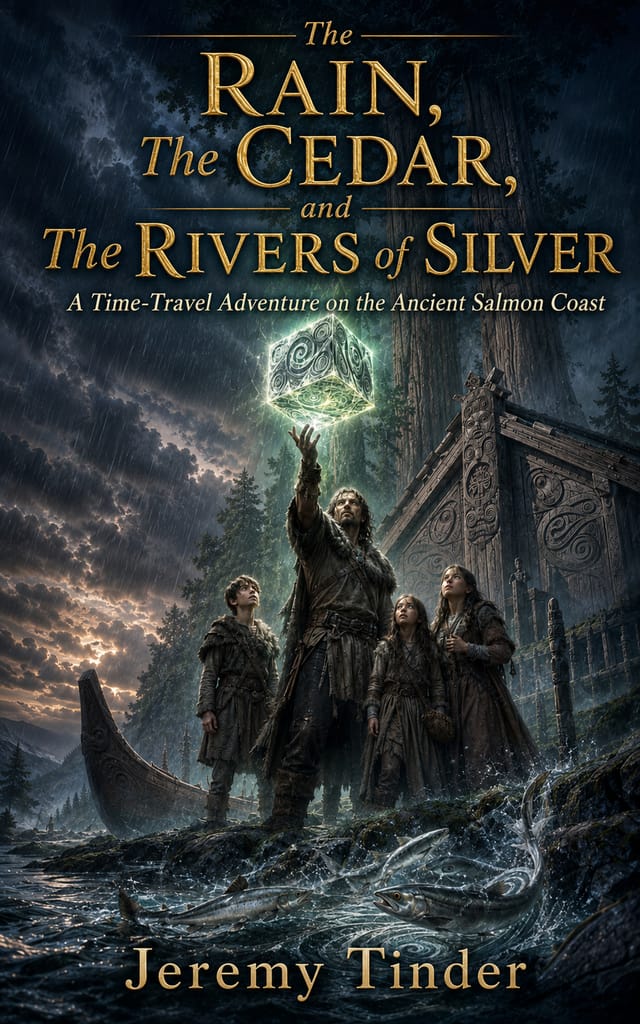
The Rain, The Cedar, and The Rivers of Silver
A Time-Travel Adventure on the Ancient Salmon Coast
A river-mouth winter village of cedar-plank great houses on the ancient Pacific salmon coast · Ancient Pacific Northwest Coast, pre-contact era
On their ninth journey through the shimmering cube, the three Carver children arrive on the rain-soaked shores of an ancient Pacific salmon coast, where cedar-plank great houses shelter whole extended families and the yearly salmon run provides such abundance that the real challenge isn't survival but learning what to do with more than you could ever need. As Beckah studies the coast's owned crests and spoken histories, Simeon apprentices under a master carver who asks him what all making is truly for, and Ellie navigates the strict customs around songs that belong to specific families, the children discover a culture built entirely around giving, firstfruits, and the belief that everything received is 'lent,' not owned.
- Reading age8-12
- Length177 pages
- Series orderBook 9 of 15
- RegionAncient Pacific Northwest Coast (an Indigenous salmon-culture society)
Get the book
Retailer links marked “coming soon” are placeholders until the official store links are published.
What readers will discover
- Pacific Northwest Coast Indigenous culture and daily life
- cedar-plank great house architecture and construction
- salmon-run ecology and seasonal subsistence economies
- totem/crest carving and formline design as a visual language
- oral history, rememberers, and cultural transmission without writing
- canoe-building and traditional woodworking tools
- potlatch-adjacent gift-giving and wealth-through-generosity systems
- biblical parallels to firstfruits and giving (introduced by the father)
Main characters in this book
- Beckah Carver
- Eldest sibling; the family's rememberer and notebook-keeper who reads the cube's living-map signs and studies the coast's oral and formline record-keeping traditions
- Simeon Carver
- Middle sibling; a builder who apprentices in cedar carving and canoe-making under a master carver
- Ellie Carver
- Youngest sibling; a listener attuned to songs, drumming, and living things, who learns the coast's owned-song customs
- Daniel Carver
- Father; a builder in Carolina who receives the family's ninth yearly wisdom and confronts holding on versus giving away
- Elizabeth Carver
- Mother; keeper of the household's decades-old 'guest pot' hospitality tradition, which mirrors the coast's giving culture
- Nulis
- A master cedar carver who mentors Simeon and tests him with a searching 'season-question' about the purpose of making things
- Tsana
- A young rememberer trained since childhood to hold her great house's crest histories; becomes close with Beckah
- Miku
- A young interpreter and companion who helps the Carver children navigate coast language and customs
- Awina
- An elder clan mother whose formal reading of the cube's warning reframes it for the family as a commissioning, not a rebuke
- Kwel
- A coast craftsman who works alongside Simeon and speaks with him about cedar, tools, and the meaning of gifts
Themes & learning topics
Guidance for parents & educators
Family-friendly historical fiction; references a historical epidemic that devastated a village generations earlier (handled gently, no graphic detail); mild themes of grief tied to lost cultural knowledge; a tense but nonviolent 'legal' moment over song ownership; underlying Christian themes of giving and gratitude woven into the family's reflections.
Recommended reading age: 8-12.
Questions about this book
Spoiler-free answers, drawn from the book itself. Spoiler answers are clearly marked and tucked behind a click.
What is the ninth book in the Cube Chronicles series about?
The Rain, The Cedar, and The Rivers of Silver sends the three Carver children through the cube to an ancient Pacific salmon coast, where cedar-plank great houses and enormous yearly salmon runs create a culture of abundance built around giving rather than keeping.
#Do I need to read the first eight books to understand this one?
No. Each book is a self-contained adventure to a new place and time, though returning readers will appreciate the ongoing thread of the family's yearly cube journeys and the accumulating 'wisdoms' Daniel Carver has learned across all nine trips.
#Who are the main characters in this book?
The story follows siblings Beckah, Simeon, and Ellie Carver on the salmon coast, alongside their parents Daniel and Elizabeth back home in Carolina, and coast characters including master carver Nulis, rememberer Tsana, interpreter Miku, and clan mother Awina.
#What historical culture and time period does this book depict?
The book is set among an ancient Pacific Northwest Coast Indigenous salmon-culture society, featuring cedar-plank great houses, carved crests, and a subsistence economy centered on the seasonal salmon run.
#Is this book appropriate for middle-grade readers?
Yes. It is written for roughly ages 8-12, with family-friendly content, no graphic violence, and themes of generosity, gratitude, and cultural respect explored through an adventure narrative.
#Does the book explain what the mysterious cube actually is?
No. Consistent with the whole series, the cube's origin and the being behind it (referred to only as 'the Maker' or 'the builders') are never shown or fully explained; the children instead find clues and warnings that deepen the mystery.
#What does Simeon learn from the master carver Nulis?
Simeon apprentices in cedar carving and canoe-making, and Nulis repeatedly asks him a probing 'season-question' about the true purpose of any made object, pushing Simeon toward the idea that things are made to be given away, not kept.
#What is the 'guest pot' mentioned in the book?
The guest pot is a longstanding Carver family tradition in which Elizabeth serves the very first portion of every meal to guests before her own children are served, symbolizing the family's commitment to hospitality and giving.
#What role does Beckah play in this installment?
Beckah continues her role as the family's chronicler, this time learning from Tsana, a coast rememberer, about how oral history, memory, and formline art are used to preserve a family's story without written language.
#Does Ellie get into any trouble with the coast's customs?
Ellie unknowingly learns and sings a song that belongs exclusively to another family under the coast's strict song-ownership customs, leading to a tense but ultimately respectful resolution in front of the whole great house.
#What themes about wealth and generosity does the book explore?
The book contrasts wealth that is hoarded with wealth that is given away, using the coast's abundant salmon runs, crest-ownership customs, and firstfruits-style ceremonies to show generosity as a discipline that keeps a family or people healthy.
#Are there any educational or classroom uses for this book?
Yes. Teachers can use it to introduce Pacific Northwest Coast Indigenous culture, salmon-based subsistence economies, oral history and memory-keeping traditions, and discussions of gratitude and community giving.
#Is there any religious content in the book?
Yes, mild and reflective. Daniel Carver draws a parallel between the coast's firstfruits-style offerings and biblical firstfruits teachings, framing giving as a spiritual discipline; the content is presented gently within the family's own faith reflections rather than as instruction to the reader.
#How does the book end, and does it set up a tenth book?Spoiler
This answer reveals plot details.
(Spoiler) The family returns home changed by what they learned, and Elizabeth gives away the actual guest pot itself — the physical object, not just the practice — to a new family on their street, passing on its rule. The narration then notes 'the tenth tooth is growing,' confirming a tenth cube journey is coming.
#What happens with the 'seventh warning' referenced in the book?Spoiler
This answer reveals plot details.
(Spoiler) A carved warning inside the cube's living archive tells the family 'the carrier does not keep; the gift is the crossing.' Clan mother Awina reinterprets it not as a rebuke but as a 'commissioning,' urging the family to remain open-handed as their responsibilities grow across future crossings.
#What does Daniel Carver's ninth 'wisdom' turn out to be?Spoiler
This answer reveals plot details.
(Spoiler) Watching Elizabeth serve the guest pot before her own children finally reveals it to him: 'Build it to give it away' — the idea that everything built, taught, or made across the family's nine journeys was always meant to be handed to someone else.
#Is the cube or its maker ever shown directly in this book?
No. As throughout the series, the being behind the cube is never depicted or seen — only implied through warnings, carvings, and the effects of its light.
#Reader questions & answers
No approved reader questions yet. Be the first to ask!
Ask a question about this book
Sign in or create a free account to ask a question. You never need an account to read.